White Paper on OTEC: Advancing Deployment and Innovation (March 2025)
Date: October 26, 2026 at 19:54 GMT
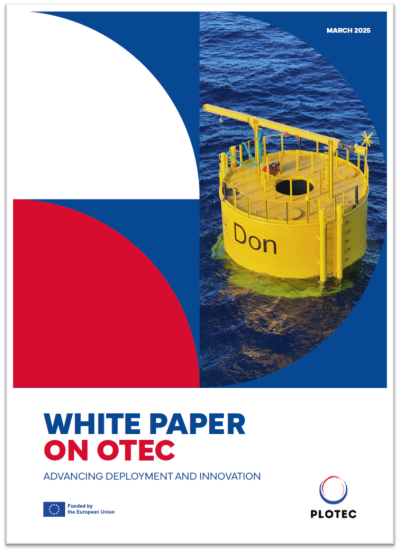
This White Paper on OTEC was produced within the scope of PLOTEC, an EU-funded project.
This white paper provides a strategic and technical overview of Ocean Thermal Energy Conversion (OTEC), examining its potential, key challenges, and pathways towards commercial-scale deployment. Building on the
2024 White Paper on OTEC, which presented a broad assessment of economic considerations, scalability challenges, key technological components, and mitigation strategies, this publication focuses on the specific requirements for advancing OTEC towards commercial implementation. Particular attention is given to Small Island Developing States (SIDS) and tropical coastal regions, where OTEC could contribute to energy security, resilience, and the transition towards sustainable energy systems.
The white paper examines OTEC's potential to provide continuous, reliable renewable electricity, alongside complementary applications such as freshwater production, aquaculture, and seawater air conditioning. It addresses environmental and social considerations, including potential impacts on marine ecosystems, mitigation measures, and community engagement. It also assesses economic viability, financing mechanisms, and policy and regulatory barriers to deployment.
Furthermore, the document explores key technical challenges, technological innovations, and deployment strategies, drawing on experience from established offshore industries and opportunities to leverage existing industrial supply chains. It concludes with strategic recommendations to support technological advancement, overcome barriers to commercialisation, and facilitate the responsible deployment of OTEC, particularly in SIDS.